


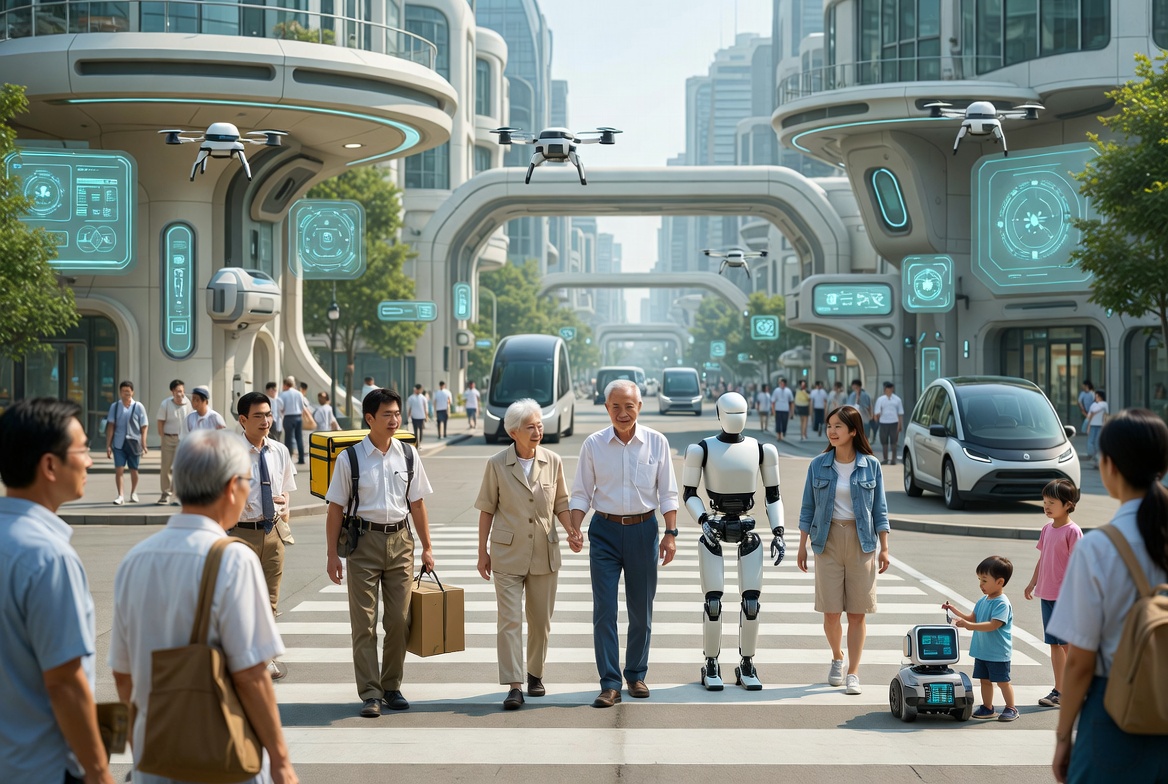
Robotics is advancing at extraordinary speed, but the future it promises is developing unevenly.
At one end of the spectrum, humanoid robots can run, climb, perform backflips and manipulate objects with increasingly human-like dexterity. Artificial intelligence systems can interpret language, analyse complex information and support decisions once regarded as the exclusive domain of human specialists. Bringing those capabilities together creates the prospect of machines that can perceive, reason and act within the physical world.
At the other end, large parts of the global economy continue to operate without reliable digital connectivity, modern telecommunications or the infrastructure required to deploy advanced automation at scale.
The result is not a single global robotics revolution, but a fragmented landscape in which countries are moving towards automation from very different starting points. Nowhere is that contrast more visible than in the debate over ageing populations and the future of work.
The demographic challenge
Ageing societies face a practical dilemma. As the proportion of older people rises, demand increases for healthcare, mobility assistance, domestic support and social care. At the same time, the number of working-age people available to provide those services may decline.
Japan provides perhaps the clearest example. Around 28% of its population is aged 65 or over, a proportion projected to approach 38% by 2050. Declining birth rates and a shrinking workforce are placing growing pressure on healthcare provision, pensions and the broader social security system.
The challenge is not simply financial. Governments may be able to allocate additional funding, but money alone cannot create nurses, carers, technicians and support workers where the available labour pool is contracting.
Robotics is therefore increasingly being considered not merely as a tool for improving productivity, but as part of the social infrastructure required to maintain quality of life.
Machines could support older people in their homes, help patients move safely, monitor changes in health, carry out domestic tasks and reduce the physical workload placed on carers. Industrial and service robots could also compensate for labour shortages in manufacturing, logistics, retail, agriculture and public services.
In this context, automation becomes a response to demographic necessity rather than a purely commercial investment.
Robots or imported labour?
Countries facing workforce shortages broadly have two options: automate more tasks or recruit additional workers from abroad.
Both approaches offer benefits, but they create very different social and economic models.
Importing human capital can address shortages relatively quickly. Migrant workers already provide essential labour across healthcare, construction, agriculture, hospitality, logistics and domestic care. Human workers bring judgement, adaptability, empathy and cultural understanding that remain difficult for machines to reproduce.
However, expanding the workforce also requires investment in housing, transport, healthcare, schools and public services. Poorly managed migration can place pressure on infrastructure that may already be struggling to meet the needs of the existing population.
Robotics presents a different proposition. A machine does not require housing, commuting infrastructure or access to public services. Once deployed, it can potentially operate for extended periods, perform repetitive or physically demanding work and reduce dependence on a continually expanding labour force.
Yet describing robotics as an infrastructure-free solution would be misleading. Robots replace one set of demands with another.
They require electricity, connectivity, maintenance, spare parts, software updates, cybersecurity and technical expertise. Advanced systems may depend on cloud computing platforms, high-performance data centres and continuous access to communications networks.
A robotic society may place less pressure on housing and transport, but considerably more pressure on energy generation and digital infrastructure.
Energy becomes the new constraint
Much of the debate around automation has focused on the purchase price of robots and the financial return they can generate. As deployment expands, energy consumption could become an equally important consideration.
A human workforce consumes energy indirectly through homes, transport, food production and public infrastructure. Robots consume it more visibly through batteries, motors, processors, sensors, communications systems and the data centres supporting their intelligence.
The rapid adoption of AI adds another layer to this demand. Training large AI models can require substantial computational resources, while operating them across thousands or millions of devices creates a continuous energy burden.
A society that deploys robots throughout factories, hospitals, warehouses, care homes and private residences will therefore need to consider more than the cost of purchasing the machines. It must account for the energy system required to keep them functioning.
This raises difficult questions.
Can electrical grids support widespread robotic deployment while also meeting demand from electric vehicles, heat pumps and industrial decarbonisation? Will countries with abundant renewable or nuclear energy gain an advantage in automation? Could energy shortages slow robotics adoption even where the technology itself is available?
The constraints governing automation may gradually shift from capital and labour towards electricity, computing capacity and network resilience.
The global infrastructure gap
These requirements also risk widening the divide between advanced and developing economies.
Countries with reliable power, strong telecommunications, established research institutions and access to investment will be able to deploy advanced robots much more rapidly. Nations without those foundations may struggle to move beyond isolated pilot projects.
A robot capable of performing highly sophisticated tasks offers limited value if it cannot connect reliably to supporting systems, receive updates or access the data needed to operate safely. Even autonomous machines still depend on a wider ecosystem of networks, technicians, standards and regulatory oversight.
This means the robotics industry cannot treat the availability of communications and energy infrastructure as someone else’s problem. Manufacturers developing systems for global markets will need to design machines that can operate under less-than-ideal conditions.
Robots may require offline capabilities, lower energy consumption, modular maintenance and resilience against intermittent connectivity. Technologies built only for highly connected environments could exclude many of the countries where automation might deliver the greatest economic and social benefits.
Care requires more than efficiency
The use of robotics in ageing societies also raises questions that cannot be answered through engineering alone.
A machine may be able to lift a patient, deliver medication or detect a fall, but care is not simply a collection of physical tasks. It also involves empathy, companionship, trust and human contact.
The objective should not be to remove people from care entirely. It should be to use robotics to reduce dangerous, repetitive and physically exhausting work so that human carers can focus on activities requiring judgement and emotional engagement.
Poorly designed automation could create highly efficient but socially impoverished care environments. Older people might remain physically safe while becoming increasingly isolated.
The most effective model is therefore likely to be collaborative. Robots can provide practical assistance, monitoring and mobility support, while people remain responsible for relationships, complex decisions and emotional wellbeing.
This principle extends beyond social care. The future workplace is unlikely to involve a simple choice between humans and machines. In many sectors, success will depend on how effectively the two can work together.
Choosing the society automation creates
Robotics is often discussed as though technological progress follows an inevitable path. In reality, societies make choices about where machines are deployed, what problems they are intended to solve and who benefits from the resulting productivity.
Automation could help countries sustain public services despite shrinking workforces. It could allow older people to live independently for longer, protect workers from injury and maintain industrial output in economies facing severe demographic pressure.
It could also concentrate economic power, increase energy demand and deepen inequality between countries with different levels of infrastructure.
The central question is therefore no longer whether robots and AI will become part of everyday life. That process is already underway.
The more important question is what kind of social, energy and economic systems will be required to support them.
Japan’s response to its ageing population may provide an early indication of what lies ahead. Other nations may rely more heavily on migration, changes in retirement patterns or improvements in human productivity. Most will probably adopt a combination of all three.
There will be no universal model. Demographics, culture, energy availability, public attitudes and infrastructure will shape each country’s approach.
The global robotics future will consequently remain uneven. Some societies may become deeply automated, with machines embedded across homes, workplaces and public services. Others will continue to depend primarily on human labour because the surrounding infrastructure cannot support advanced systems.
Robotics may offer an answer to some of the most pressing demographic challenges of the coming decades. But the technology cannot be considered in isolation.
The machines may be capable of backflips, complex reasoning and extraordinary precision. Their real impact, however, will depend on whether societies can provide the energy, networks, skills and ethical frameworks required to put those capabilities to productive use.


